
SDI vs IP in Broadcasting: Which Is Better for Live Production?
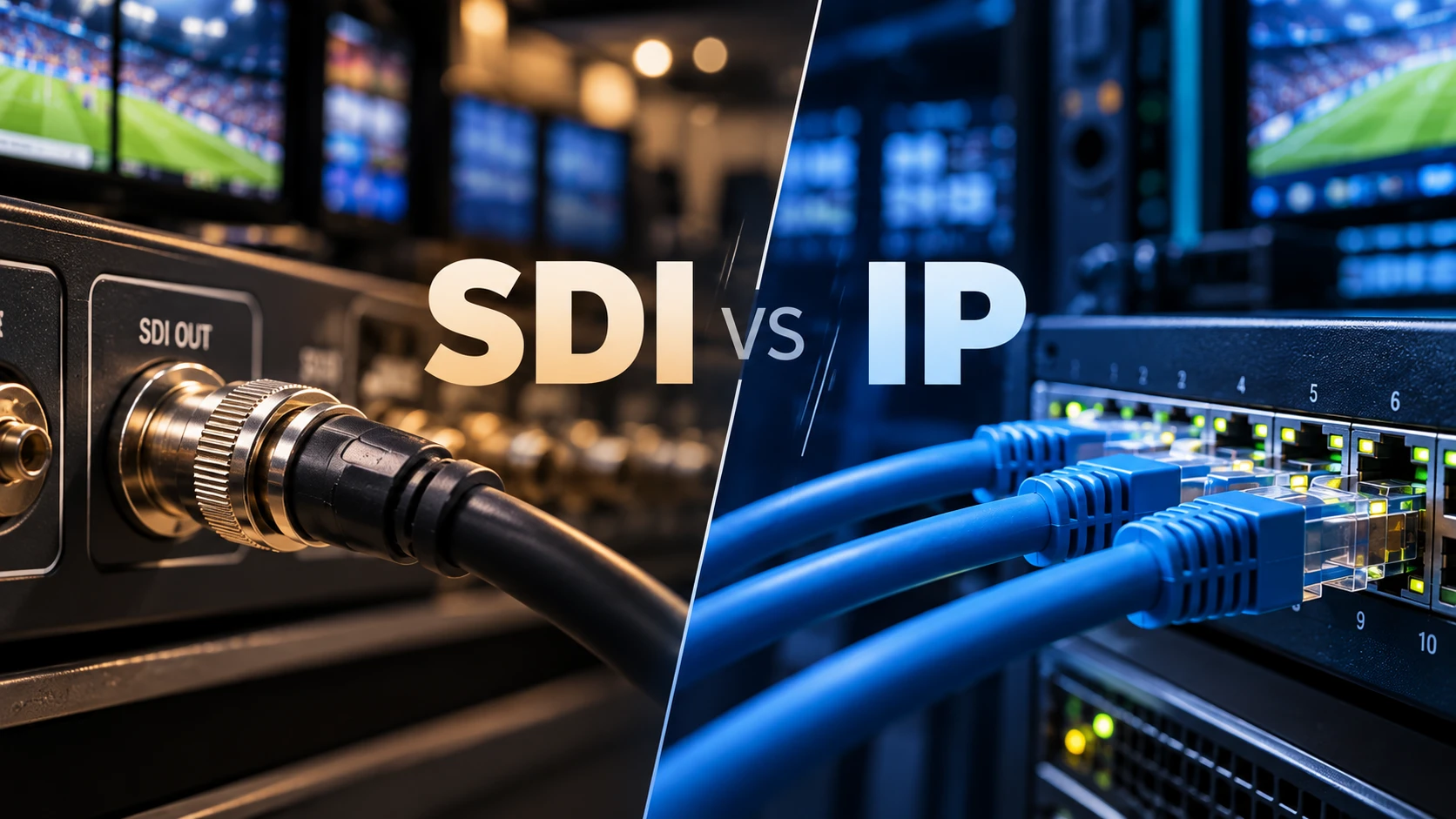
For decades, Serial Digital Interface (SDI) has been the backbone of professional broadcasting. Today, IP is changing what broadcast infrastructure can do. But at ZOOM Communications, we believe the more useful question isn't "SDI or IP?" It is "what architecture is right for the broadcast?"
The broadcast industry has always evolved alongside technology. From analogue to digital, SD to HD, HD to UHD, and now from conventional baseband infrastructure towards increasingly networked production environments, every transition has promised greater capability. Yet anyone who has delivered a major live broadcast knows that adopting technology simply because it is newer is rarely the right answer.
Today, one of the most important conversations in broadcast engineering is SDI vs IP broadcasting. Internet Protocol (IP) has unquestionably changed the possibilities for live production. Standards such as SMPTE ST 2110 allow professional video, audio and ancillary data to travel as separate, synchronized streams across managed IP networks, opening the door to far more flexible and scalable broadcast architectures.
But does that mean SDI has reached the end of the road? From our experience at ZOOM Communications, the answer is no. The future of broadcast is not simply about replacing SDI with IP. It is about designing infrastructure around the requirements of the production.
Why SDI Remains a Broadcast Workhorse
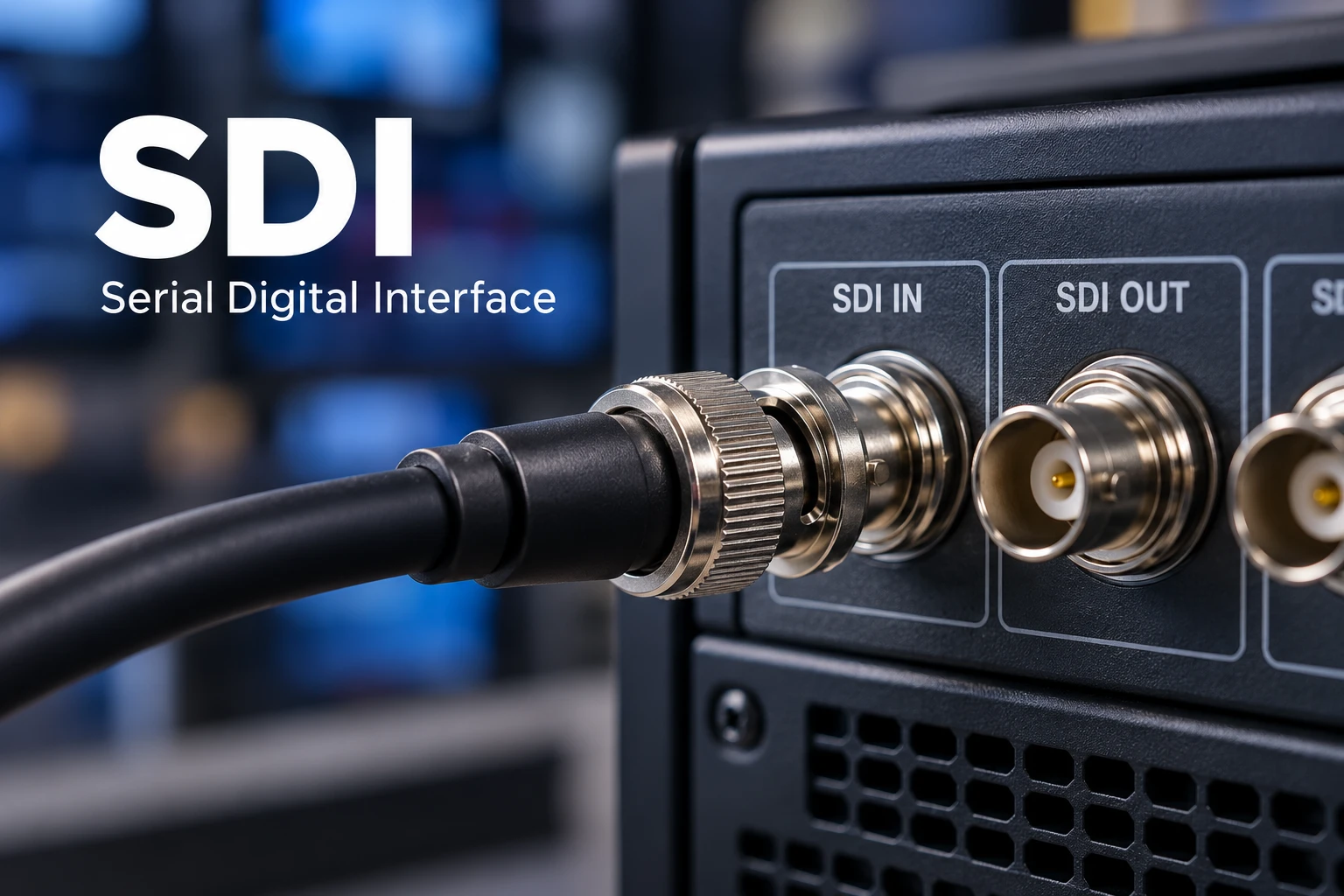
There is a reason SDI has remained fundamental to professional broadcasting for decades. It is deterministic, familiar and purpose-built for transporting professional video. A source connects to a destination through a clearly defined signal path, making SDI systems relatively straightforward to design, operate and troubleshoot.
In the high-pressure environment of live broadcasting, that simplicity has enormous value. When hundreds of signals are moving through an Outside Broadcast operation and millions of viewers are watching the output in real time, reliability is not merely a technical specification. It is the foundation of the production.
SDI also benefits from a mature ecosystem of cameras, routers, vision mixers, replay systems, monitoring infrastructure and engineering expertise. For many productions, particularly where the required scale and topology are well understood, SDI remains an extremely effective broadcast technology.
So, the case for IP cannot simply be that it is newer. It has to enable something better.
What IP Changes
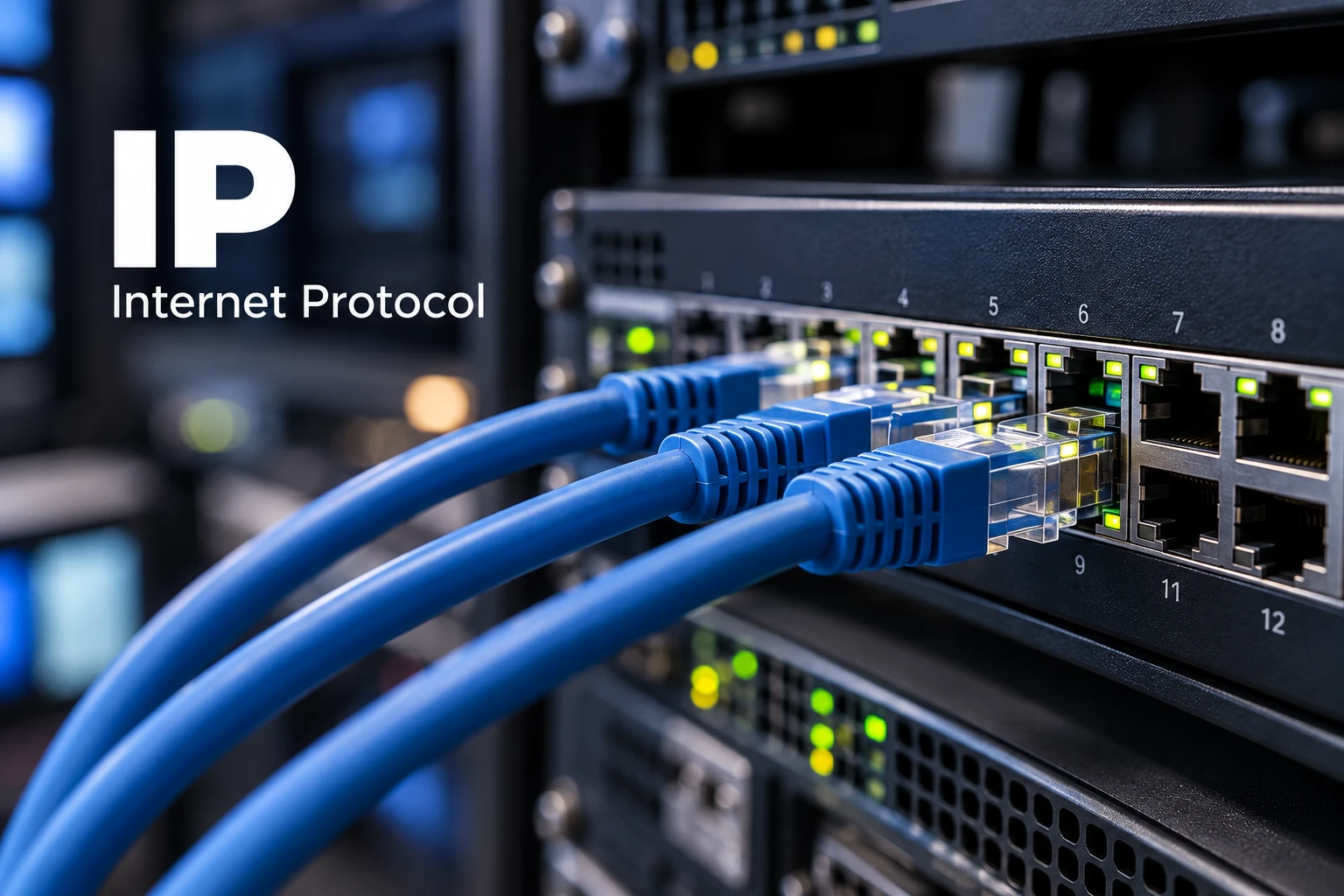
This is where IP broadcast workflows become transformative. Traditional SDI infrastructure is fundamentally based around physical signal paths. IP turns media into networked resources.
With SMPTE ST 2110, video, audio and ancillary data can exist as independent essence streams on a managed IP network while remaining precisely synchronized. Instead of treating the complete SDI signal as a single entity, different elements can be routed and processed independently. That changes the architecture of a broadcast facility.
Resources no longer need to be thought of exclusively in terms of physical inputs and outputs. Infrastructure can become more distributed, scalable and adaptable. For large broadcasters and production environments, this can create significant advantages.
- Scalability. IP networks can make it easier to expand infrastructure without continuously increasing the size and complexity of conventional baseband routing.
- Resource sharing. Production resources can increasingly be made available across different locations and workflows rather than remaining tied to a single physical facility.
- Flexible routing. Video, audio and data can be independently routed to multiple destinations across the network.
- Remote production. IP connectivity is an important enabler for REMI and distributed production models, allowing parts of the production chain to operate away from the event venue.
- Infrastructure convergence. Broadcast media and other data services can increasingly operate over common network technologies rather than requiring entirely separate technology stacks. SMPTE identifies this convergence as one of the significant advantages of the transition towards ST 2110 environments.
And as productions become larger, more distributed and more software-driven, these advantages become increasingly significant.
But IP Introduces a Different Kind of Complexity
Moving from SDI to IP does not eliminate engineering complexity. It relocates it. An SDI engineer traditionally thinks extensively about signal paths, routers, synchronization, cable lengths and physical infrastructure. An IP broadcast environment adds another discipline: network engineering.
Multicast behaviour, bandwidth management, Precision Time Protocol, network topology, packet timing, traffic shaping, monitoring and cybersecurity become part of the broadcast engineering conversation. Redundancy also has to be deliberately engineered. Technologies such as SMPTE ST 2022-7 can provide seamless protection by transmitting redundant RTP streams across diverse network paths and reconstructing the output at the receiver.
The technology is powerful. But the underlying principle remains exactly the same as it was in SDI: a broadcast system is only as reliable as the engineering behind it.
ZOOM's View: Start With the Broadcast, Not the Technology
At ZOOM Communications, our experience has taught us to avoid treating technology choices as ideology. We work across IP and SDI workflows, UHD and HD environments, REMI and on-premise production, because different productions require different architectures.
The question therefore isn't "Can this production be IP?" The better questions are:
- What does the production need to achieve?
- How many signals need to move?
- Where do those resources need to be available?
- What level of redundancy is required?
- How distributed is the operation?
- How quickly must the system be deployed?
- And ultimately, what architecture gives the production team the greatest operational confidence?
Those questions might lead to an SDI system. They might lead to an ST 2110 IP environment. Increasingly, they lead somewhere in between.
The Rise of the Hybrid Broadcast Environment
For the foreseeable future, we believe hybrid SDI-IP broadcast infrastructure will remain an important part of the industry. That is not a compromise. In many situations, it is simply good engineering. A production can retain the deterministic simplicity of SDI where it makes operational sense while using IP where networking creates genuine advantages in scale, distribution, routing or resource sharing.
ZOOM's own broadcast infrastructure reflects this reality. Our Outside Broadcast capabilities span Flyaway Systems and REMI hubs, with routing systems scaling from 128×128 to 1024×1024 and more than 400 12G and IP-ready camera channels, supported by extensive audio, communications, replay and RF infrastructure.
That infrastructure has to operate across dramatically different production environments. From cricket and football to multi-sport events, entertainment and major live productions, there is no single architecture that is automatically right for every job. For example, ZOOM's IPL operations have evolved to support ten 4K kits across twelve venues, incorporating 400 camera channels, extensive replay infrastructure and high-capacity hybrid routing.
At that scale, the conversation stops being about whether one technology is theoretically superior. It becomes about designing an ecosystem in which every component works reliably as part of the whole.
IP Is More Than a New Cable
Perhaps the biggest mistake broadcasters can make when approaching IP is thinking of it simply as a replacement transport layer for SDI. The real opportunity is much larger.
SMPTE itself notes that the significance of ST 2110 goes beyond replacing SDI. Moving professional media onto IP infrastructure creates opportunities for entirely new applications and workflows based on IT protocols, software and networked infrastructure. That distinction matters. If IP is implemented only to recreate an existing SDI architecture using Ethernet switches, much of its potential is lost.
The larger opportunity lies in what happens once production resources become network-accessible: distributed production, centralized resources, remote operations, more flexible facilities and eventually deeper integration with virtualized and cloud-based production systems. That is where IP becomes genuinely transformative.
So, SDI or IP?
Our answer is: both, where they make sense. SDI remains an exceptionally mature and dependable broadcast technology. IP offers extraordinary flexibility, scalability and the ability to rethink how production resources are connected and shared. And hybrid architectures allow broadcasters to take advantage of both while managing the transition at a pace appropriate to their operations.
At ZOOM Communications, our role has never been simply to deploy equipment. Across Outside Broadcast, Flypacks, OB Trucks, REMI production and System Integration, we design broadcast systems around the demands of the production itself. Our experience spans marquee global sporting and live events as well as turnkey broadcast system design and engineering.
Because ultimately, viewers don't care whether the pictures reaching their screens travelled over coaxial cable or Ethernet. They care that they arrived. And in live broadcasting, that is still the standard that matters most.